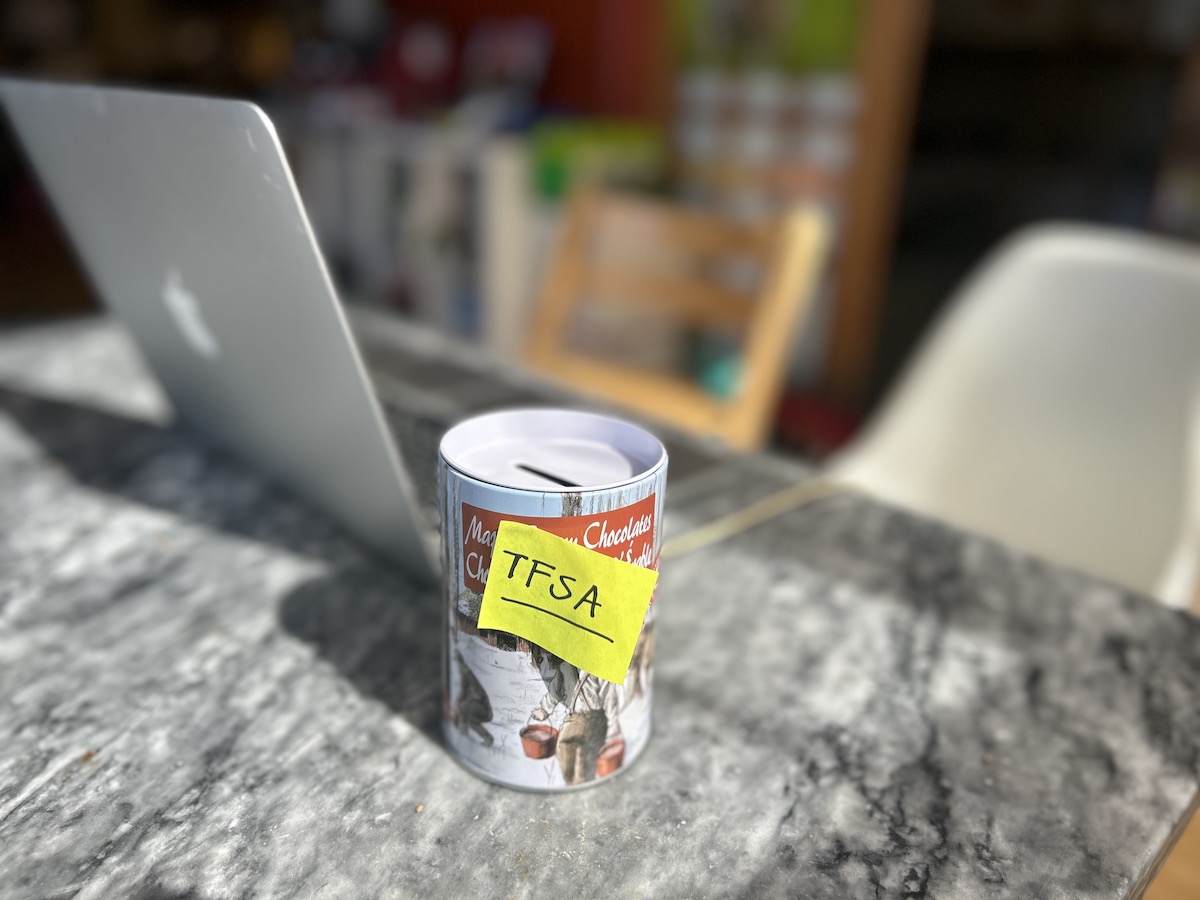
TFSA: How I Use It for Tax-Free Growth
In this post, I’m sharing my personal experience with TFSAs as a Canadian woman. Please keep in mind that these are the lessons I’ve learned over the years and are not professional financial advice. When I first started working, the RRSP (Registered Retirement Savings Plan) was the main registered retirement tool available. The TFSA (Tax-Free Savings Account) didn’t exist yet, as it was only introduced in 2009. Looking back, I wish the TFSA had been around earlier! I would have contributed to a TFSA when I had a lower salary to take advantage of tax-free growth from the start, while saving and accumulating my RRSP contribution room for later, when I was further along in my career and earning a higher income.
The “Tax-Free Savings Account” – Not Just for Savings
One of my favourite TFSA tips is to remember that a TFSA isn’t just a savings account. In reality, a TFSA is a versatile vehicle that can hold a variety of investments. I think a lot of the confusion has to to with the name, which I’ve always found a little misleading. To me, it sounds like a simple parking spot for cash. I’d love to see it rebranded as a Tax-Free Growth Account or Tax-Free Investment Account, names that would encourage Canadians to use it to its full potential.
Even though I didn’t have the chance to open a TFSA at 18, I will make sure my kids do. I think the TFSA is a powerful tool because of the tax-free aspect: your investments grow without being taxed, AND you can withdraw funds without paying any taxes.
Who Can Open a TFSA?
To open a TFSA, you must:
- Be a Canadian resident
- Have a valid Social Insurance Number (SIN)
- Be at least the age of majority in your province
Living in Quebec, what I didn’t know is that the age of majority varies across Canada:
- 18 years old: Alberta, Manitoba, Ontario, Prince Edward Island, Quebec, Saskatchewan
- 19 years old: British Columbia, Newfoundland and Labrador, Nova Scotia, New Brunswick, Northwest Territories, Nunavut, Yukon
The good thing is that even in provinces where the age of majority is 19, you start accumulating TFSA contribution room at 18. Some institutions may allow you to open an account with a co-signer or guardian.
TFSA: More Than a Savings Account
A TFSA is surprisingly versatile. You can hold a wide range of investments, including:
- Stocks
- Exchange-Traded Funds (ETFs)
- Bonds
- Guaranteed Investment Certificates (GICs)
- Mutual funds
Personally, I hold stocks and ETFs in my TFSA, although what you hold should really depend on your risk profile.
What I found interesting (though not really surprising given that “Saving” is part of the TFSA’s name), a 2019 RBC/Ipsos survey found that 42% of TFSAs were held in cash or savings accounts. And a more recent TD Bank survey from 2025 found that 65% of Canadians hold a TFSA, but 39% aren’t investing the money, with 41% of young Canadians (Gen Z and millennials) specifically keeping it in cash, likely due to high living costs and a challenging job market. While this is certainly safe, I think that keeping money in low-interest savings can erode your wealth due to inflation. From my experience, by steadily making contributions and investing them wisely, I was able to build wealth over time.
Compounding Example: TFSA with GIC vs TFSA with Diversified Portfolio
Let’s say you contribute $7,000 per year. Here is what you could end up with after 20 years (hypothetically as no returns are guaranteed):
| Investment Choice inside TFSA | Average Annual Return | Total After 20 Years |
| GIC | 3.5 % | about $200,000 |
| Diversified portfolio of ETFs + stocks | 8 % | about $320,000 |
Note: These totals are based on assumed rates and are for illustrative purposes only. Actual investment returns are not guaranteed and can be higher or lower.
It’s true that a GIC in a TFSA offers stability and guaranteed returns. A diversified ETF/stock portfolio in a TFSA carries more risk than a GIC. However, there is also a potential to grow far more over 20 years. In the example above over $120,000 more, all tax-free. The key takeaway here is that a TFSA is just the container. You can’t actually buy a TFSA. What matters is what you buy or invest inside it.
TFSA Contribution Limits
The TFSA annual contribution limit for 2025 is $7,000. If you were 18 or older in 2009 and have been a Canadian resident since then, your cumulative contribution room is $102,000 if you have never contributed.
Here’s a simplified table of past contribution limits until 2025:
| Years | Annual Contribution Limit |
| 2009–2012 | $5,000 |
| 2013–2014 | $5,500 |
| 2015 | $10,000 |
| 2016–2018 | $5,500 |
| 2019–2022 | $6,000 |
| 2023 | $6,500 |
| 2024–2025 | $7,000 |
Note: I grouped the years where limits were the same to simplify the table.
Checking My TFSA Contribution Room
What happens if you lost track of your contribution room? This happened to me recentlyI, as I hadn’t contributed for a couple of year, but did so before, but I wasn’t quite sure if I did contribute a small amount or not. I was confused, but didn’t want to end up paying any penalities, so I checked the CRA’s website ( My Account portal). To do this, I needed my:
- social insurance number
- most recent notice of assessment
- CRA login credentials
You can also call the CRA’s Tax Information Phone Service at 1-800-267-6999 and they will help you out.
When I checked my contribution room, it said that the TFSA contribution room was as of January 1, 2025, with a little warning sign. That’s definitely something to keep in mind because it means that I have to deduct any TFSA contributions that I made in the meantime.
Checking your TFSA contribution room helps avoid costly over-contribution penalties (1% per month on the excess). Remember: if you withdraw funds, you can only re-contribute that amount the following calendar year.
Managing Multiple TFSAs and Consolidating Accounts
One thing I learned from my own experience: it’s helpful to keep track of all your accounts. I used to have TFSAs scattered across a few banks. You can hold multiple TFSAs at different institutions, but your total contribution room stays the same.
To avoid having to log into several different tradeing platforms, I recently consolidated all my TFSAs into one Wealthsimple account, an online broker. I like that:
- They have commission-free trading for stocks and ETFs
- They allow fractional shares
- They provide automatic dividend reinvestment (and you can also track your monthly, and annual dividend payouts. Even though, I am not only focused on dividends, this is a neat feature).
Consolidating makes it much easier to track growth. I even log in sometimes just to see my overall totals updating in (almost) real time. It’s a bit addictive! I’ll soon write another blog post to review the platform in more detail.
If you’re considering Wealthsimple, here’s my referral code PNG6FW and link (full disclosure, you get $25, and I get a small commission when you use my referral code or link). What’s more Wealthsimple is currently running a gold giveaway until December 5, 2025. You get one entry per dollar you transfer. But be sure to register first and read their T&Cs.
TFSA or RRSP? Understanding the Differences
If you wonder, how does the TFSA compare to an RRSP. Here are some of the main differences:
- RRSP contributions reduce your taxable income in the year you contribute, which is ideal when your income is higher.
- TFSA contributions don’t reduce taxes now but allow tax-free growth and withdrawals anytime without affecting federal benefits.
- The TFSA contribution room is not tied to your income.
Dividends in a TFSA and U.S. Withholding Taxes
What I didn’t know when I started investing and only found out later: U.S. dividend-paying stocks in a TFSA are subject to a 15% U.S. withholding tax. Unlike an RRSP, the TFSA isn’t recognized under the Canada–U.S. tax treaty, so this tax cannot be recovered.
This is why, I keep most U.S. dividend-paying stocks in my RRSP and use my TFSA for other growth investments. For high-growth tech stocks, the dividends are often negligible, so I don’t worry too much about where I hold them.
The TFSA: More Than Just Retirement Savings
A lot of people think of the TFSA mainly as a retirement vehicle and that’s definitely how I’m using mine with the ultimate goal of growing it into a $1 million TFSA. Imagine being able to withdraw a million dollars tax-free? That’s life-changing. Right now my RRSP is about 4 times the size of my TFSA, which is why I am planning to focus a bit more on my TFSA over the next few years to get a bit closer to my goal.
Although the TFSA is often seen as a retirement savings (and let’s not forget investment) tool, it’s actually useful for a variety of financial goals. You can use it for any project or life goal: buying a home, starting a business, or even a dream vacation. The flexibility is huge. You can withdraw funds whenever you need them, and you can then add back the amount that you take out the following year.
As of now I am focused on using my TFSA for retirement, which means I am not trying to touch it until then. As I get closer to retirement, I plan to shift some of my holdings into safer, income-generating investments like ETFs, bonds or dividend-paying investments. That way I can lock in more stability and cash flow instead of chasing high growth.
The Risk Side of the TFSA
Of course, there’s a flip side to the TFSA’s flexibility. Let’s say you contribute $7,000 into a stock that drops to $6,000 and then decide to withdraw it. You can only recontribute the $6,000 the following year, not the full $7,000 you originally put in. In other words, you’ve permanently lost that $1,000 worth of contribution room. So that’s definitely something I am always aware of.
TFSA Withdrawals and Their Impact on Government Benefits
My retirement is still more than a decade away, but I find it’s amazing to know that TFSA withdrawals do not count as income (whereas RRSP withdrawals do count as income), which means they also don’t affect federal income-tested benefits like Old Age Security or the Guaranteed Income Supplement. This makes TFSAs a very flexible tool for building wealth over time.
Women and TFSA Balances: What the Data Really Shows
I personally love reading personal finance articles, and I’ve noticed that many of these stories feature men with high-value TFSAs (think millions of dollars). While it can be a bit discouraging to look at my own TFSA value (I’ve diligently contributed but am far from a million dollars) I have to remind myself that these are outliers. Plus, the hundreds of stories about investors who lost money trading high-risk stocks or options rarely make the headlines, probably because they aren’t as “newsworthy.”
In reality, it’s important to remember that overall, women are actually doing quite well. According to CRA data from 2020, there were about as many women TFSA holders as men. In total numbers, there were slightly more women overall, which makes sense since there are more women than men in Canada. Interestingly, though, when you look closer, a slightly higher proportion of men maximize their TFSA contributions: about 9% of men versus 8.5% of women.
For me personally, I make it a point to maximize my TFSA contributions whenever possible, because that’s where tax-free growth really adds up over time, even if the headlines tend to spotlight the very few who hit those multi-million-dollar balances.
My TFSA Strategy
My strategy in the past was to max out RRSP contributions and invest the tax refund into my TFSA right away or as early in the year as I can. By contributing my full annual TFSA room early in the year, my money had more time to grow and work for me.
Unfortunately, over the past 2-3 year, I couldn’t contribute the full amount due to an entrepreneurial venture, so now I’m playing a bit of catch-up (which is why I also had to look up my TFSA contribution room as I lost track).
Final Thoughts
Despite its name, the TFSA is far more than a “savings account.” It’s an extremely flexible, and above all TAX-FREE vehicle that I’ve used to build a well-diversified portfolio. In my experience, starting early and making consistent contributions allowed me to benefit from compounding over time, even with modest amounts.
Disclaimer: This blog post reflects my personal experience and perspective. It is not intended as financial advice. For personal financial guidance, please consult a qualified financial professional in Canada.